Another mass shooting targets young people; let’s move towards making it one of the last

As most Americans know, there was a shooting on the Florida State University campus on April 17. I learned about it when my younger child, a freshman at FSU, texted me they were safe and staying in place.

As relieving as that news was, I am profoundly saddened for the FSU community; two adults died that day and six students were injured. And the entire campus community was affected: Some students witnessed the shooting and fled, while all on campus had to stay in place or barricade themselves. Statistically, we know some of them will develop Post-Traumatic Stress Disorder.

The accounts from the campus were agonizing.

As CNN reported, FSU junior McKenzie Heeter witnessed the gunman shoot a woman in the back. “… That’s when I realized there was no target. And that it was anybody he could see,” Heeter said. “And I took off.” And as she began to run, “It was just shot after shot after shot.”

Following the shooting, Florida State canceled all events, including a symposium created in honor of Maura Binkley, a 21-year-old FSU student murdered in 2018 at a Tallahassee yoga studio shooting that killed another person and injured several others.

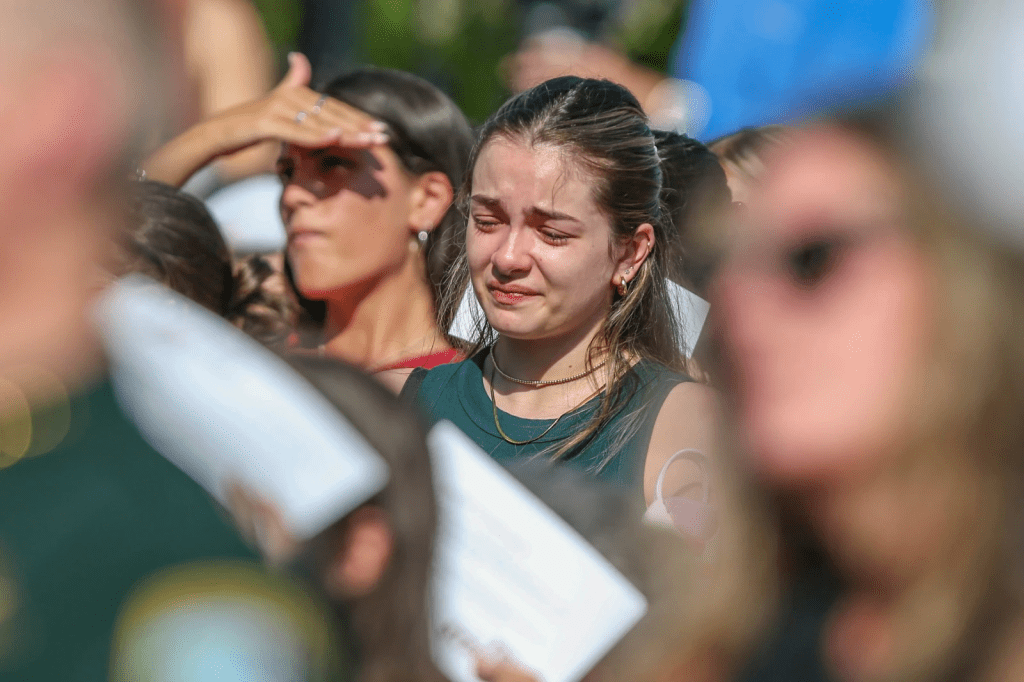
Here is an Associated Press photo of an FSU student at a vigil the day after the shooting:
Americans are highly vulnerable to being victims of mass shootings, as 73% of such shootings in the highly developed world between 1998 and 2019 took place in the US, according to a study by sociologist Jason R. Silva.

That statistic is not surprising, because the United States also has far more firearm deaths overall than comparable countries. Our nation’s firearm- homicide rate is 25 times higher and suicide-firearm rate 8 times higher than other high-income countries, according to the nonpartisan Rockefeller Institute of Government.

I don’t have all the answers for how American can solve this problem. I do know the science tells us that nations that have restricted access to guns have lower homicide rates.

And other nations that have had mass shootings have responded with legislation to limit gun violence, as The New York Times reported in 2022. This includes Canada, Norway, New Zealand, and Britain, which has one of the lowest firearm homicide rates in the world.

An interesting case study is Australia. After a mass shooting there in 1996, its conservative prime minister moved into action early in his administration.

“After this wanton slaughter, I knew that I had to use the authority of my office to curb the possession and use of the type of weapons that killed 35 innocent people,” John Howard wrote in an op-ed for The New York Times in 2013.

It wasn’t easy, but Australia wound up with comprehensive legislation that included banning semi-automatic rifles and pump-action shotguns and rifles; granting licenses to own firearms only if potential owners proved they had a reason, such as hunting, to own one; creating a buyback program for firearms that had been prohibited; limiting all gun sales to licensed dealers and requiring them to be reported to the police; and instituting a 28-day waiting period for gun purchases.

Since the legislation’s enactment, there has been a dramatic reduction in mass shootings. While it is possible this is due to chance, a study testing that possibility “found the odds against this hypothesis are 200,000 to one,” said professor Phillip Alpers of the University of Sydney.

How could the United States follow Australia’s lead? I hope it’s not too late to remember that our country has a tradition of coming together and finding bipartisan consensus on tough issues.

Prime Minister Howard has written in changing Australia’s laws he did not face a gun lobby as powerful as the US National Rifle Association. But for those interested in historical perspective, the NRA did not always oppose gun legislation; it actually used to work with the government on limiting gun trafficking.

And we do have a good starting point for consensus: Most Americans favor stricter gun laws; the Pew Research Center puts the number at 58%, with 26% saying the laws are about right and only 15% wanting them laxer. Additionally, gun owners themselves often support measures to limit gun availability.

Army veteran and retired teacher Richard Small of Charlotte, Texas, a longtime NRA member, drew national attention in the aftermath of the Uvalde, Texas, school shooting that killed 19 students and two teachers in 2022. He turned in his AR-15 rifle to local police, recognizing he didn’t need it and not wanting it to wind up in someone else’s hands (the gunman responsible for the massacre bought two AR-15s right after his 18th birthday).

Here is a photo of Mr. Small getting paperwork after handing in his rifle:

Mr. Small also became more vocal about gun control, and was moved when the public responded overwhelmingly positively to his actions. As he put it, “It hasn’t been the hate mail that I thought I was going to get.”

Shortly after the Uvalde shooting, Mr. Small was leaning against staying an NRA member. He has alternatives, including 97Percent, founded in 2019 and devoted to keeping the Second Amendment and reducing gun violence via research-driven policy initiatives that have the support of people who own guns and those who don’t.

In writing about this issue, I hope most fervently that you won’t forget about the Florida State community. You can honor them – and the many other communities and people affected by gun violence – by talking to your neighbors, writing or calling your congressperson or local representative, or getting involved with or donating to 97Percent or other groups exploring or advocating for solutions, including Moms Demand Action, Brady, Giffords, or in Rhode Island, the RI Coalition Against Gun Violence.

A horrific irony of the FSU tragedy was that it was the second mass shooting for a few students, as some had attended Marjory Stoneman Douglas High School in Parkland, Florida, where 17 people were killed and 17 wounded when a 19-year-old man opened fire on Valentine’s Day in 2018.

One of them was Jason Leavy, a freshman in high school when the shooting took place and now just a few days from graduating from FSU. He told a reporter from the Tallahassee Democrat the massacre had led him to major in psychology and to be affected by PTSD. Although he believes the constitution gives citizens the right to have guns, he wants legislation to limit what types of firearms are legal and who can own them.

“I think that’s common sense,” Leavy said, “and even if you disagree, there needs to be a solution because it seems like certain people say, ‘It is what it is, we have to accept it,’ and I don’t want to accept children dying, personally.”

Why detentions and deportations matter to children’s wellbeing

Children’s wellbeing, and that of adults, begins with safety. As an American, I have been grateful to have lived in a country that was founded on the idea that people should be safe and secure. It’s right there in the preamble to our Constitution that set up our system of government: We the People of the United States, in Order to form a more perfect Union, establish Justice, insure domestic Tranquility, provide for the common defence, promote the general Welfare, and secure the Blessings of Liberty to ourselves and our Posterity, do ordain and establish this Constitution for the United States of America.

In recent days we are seeing our government take students from other countries who are in the United States legally and detain them, sometimes in horrifying fashion, as we could literally see in the case of Rumeysa Ozturk, a Turkish graduate student at Tufts University in metro Boston, as captured in this video:

Which raises a question: Is our government protecting us – or in the words of the Constitution, insuring domestic tranquility – by taking her into custody?

We don’t know. She has not been charged with a crime. The one thing we do know was that she wrote an opinion piece, along with three fellow students, for the Tufts student newspaper, in which they criticized the university for not taking action against Israel in the aftermath of the war in Gaza.

Even criminals accused of the worst crimes have rights in this country. But Ms. Ozturk was flown to Louisiana despite a judge’s order that she stay in Massachusetts, according to The Guardian. It took her lawyer nearly a day to locate her and, without her medication, she suffered an asthma attack while in custody, according to court papers cited in The New York Times.

If Ms. Ozturk is dangerous, I think Americans would like to know how. One would assume the government had very specific information about her actions before her detention. But a Department of Homeland Secruity spokesperson said only – without offering any evidence – that Ms. Ozturk supported Hamas, the Islamist group that the US government first designed a terrorist organization in 1997 and which attacked Israel in October 2023.

Speaking on Ms. Ozturk’s detention, Secretary of State Marco Rubio said to reporters: “If you apply for a visa to enter the United States and be a student, and you tell us that the reason you are coming to the United States is not just because you want to write op-eds but because you want to participate in movements that are involved in doing things like vandalizing universities, harassing students, taking over buildings, creating a ruckus, we are not going to give you a visa.” He also said: “We gave you a visa to come and study and get a degree, not to become a social activist that tears up our university campus. We’ve given you a visa and you decide to do that we’re going to take it away.”

There is no evidence that Ms. Ozturk did any of those things.

In fact, the chair of Ms. Ozturk’s academic department, the Eliot Pearson Department of Child Study and Human Development, co-authored a webpage following her detention that describes her as an outstanding student and teacher.

“Even in a department focused on human development, Rumeysa stands out as someone who reminds us daily of the importance of protecting children, cultivating joy, and connecting to our own deeper humanity. We are not the same without her steady, gentle presence, Tufts professors Tama Leventhal and Sara Johnson wrote.

Why am I writing about these matters in a blog about children’s wellness? Because the country we hand to our children won’t be one in which their safety is guaranteed if we can’t ensure the safety of everyone who is here now.

Ms. Ozturk’s detention is notable by itself, but of course hers is not alone. There are multiple cases of students and professors who are being targeted for deportation, often with limited evidence provided on their cases. This includes Mahmoud Khalil, a Columbia graduate student and Palestinian activist who has led campus protests and whose wife is an American citizen who is expecting a baby soon. Like Ms. Ozturk, he was taken to an ICE detention center in Louisiana.

While what we are seeing is shocking, we shouldn’t be surprised. As Conor Friedersdorf wrote in The Atlantic, President Trump said last year while campaigning in New York of campus protests over the war in Gaza, “One thing I do is, any student that protests, I throw them out of the country.”

As Friedersdorf notes, even archconservative Ann Coulter questioned recent Trump administration actions, writing on X, “There’s almost no one I don’t want to deport, but, unless they’ve committed a crime, isn’t this a violation of the first amendment?”

As three academics who have studied the rise of authoritarian government in Turkey wrote in The Atlantic magazine, President Donald Trump is following an authoritarian playbook in which he is “counting on the support of mainstream Americans who hate Hamas more than they respect the Constitution.”

Writing of Khalil’s detention, Adam Serwer, also of the Atlantic, hit the matter that to my mind all patriotic Americans desiring to preserve a nation of liberties for their children and grandchildren should think about very hard:

“It does not matter if you support the Israelis or the Palestinians. It does not matter if you are a liberal or a conservative. It does not even matter if you voted for Trump or Kamala Harris. If the state can deprive an individual of his freedom just because of his politics, which is what appears to have happened here, then no one is safe. You may believe that Khalil does not deserve free speech or due process. But if he does not have them, then neither do you. Neither do I.”

Please stand up for Ms. Ozturk, Mr. Khalil, and anyone else who is having their first-amendment and human rights violated. Do it for your children and grandchildren — and the country you want them to live in.

How can you stand? You can always call or write your representatives or senators. Or the White House. Talk to your neighbors, no matter their political leanings. Or take part in the Hands Off mass mobilization taking place nationwide on April 5. I hope I’ll see you there.

Why What the US is Doing with Ukraine and Russia Matters to Children

Just over three years ago, on March 6, 2022, The New York Times reported on a relatively small event in the 11-day-old war Russia had launched against Ukraine. The story told of a Russian attack that killed four Ukrainian civilians fleeing the war.

The victims were a mother, her 18-year-old son and 9-year-old daughter — and a volunteer from the Irpin Bible Church, Anatoly Berezhnyi, 26, who had raced to their side to try to shepherd them to safety. Of the attack, his pastor said, “I do not know how God can forgive such crimes.”

Here is the photograph. It is graphic, but if you can, please view it. It documents a crime against humanity.

I have never forgotten family in the photo. As reported in a very moving article and an interview with the photographer, the boy’s name was Mykyta Perebyinis. As the war began, he was sleeping during the day and staying up nights so that he could awaken his sister, Alisa, and mother if they needed to move due to shelling. His father was trapped in Eastern Ukraine, where he had gone to take care of his own mother, who had contracted Covid-19, before the war broke out. The children’s mother, Tetiana, 43, worked for a software company that had offices in California and had stayed near the fighting instead of evacuating earlier because she was trying to figure out how to help her own mother, who had Alzheimer’s (and who along with Ms. Perebyinis’ father was behind them when the mortar struck — but they survived).

The sub-headline of the first Times article reporting the attack read: “The attach in Irpin, west of the capital, suggested either direct targeting of evacuees or disregard for the risk of civilian casualties.” At the time, there was confusion and astonishment that such an attack on innocent people trying to escape conflict could occur.

But the Russians have attacked civilians countless times. The war has killed more than 12,300 civilians, and at least 650 children, according to the United Nations Deputy High Commisioner for Human Rights. Amnesty International has documented that Russian strikes in 2024 continued to injure and kill innocent Ukrainians.

Additionally, the Russians have damaged or destroyed more than 1,500 schools and colleges and 700 medical facilities.  When schools were reopened in Russian-controlled territories, Russia turned education into propaganda, changing the facts of history and trying to wipe out Ukrainian culture, as Amnesty International documented in a research briefing in December 2023.

These war crimes and violations of human rights are why I am especially committed as a child psychologist to standing up for Ukraine. And why it is dismaying beyond words that President Trump has taken multiple actions favorable to Russia.

These actions, summarized well in a recent article in The Guardian, include:

— Making a direct call to Russian President Vladimir Putin to start negotiating the end of the war, which left our ally Ukraine out of the process as it started.

— Berating Ukranian President Volodymyr Zelensky in the White House, telling him, among other things, “You’re not in a good position. You don’t have the cards right now.” (That is definitely taking sides; Russia in its war effort last year lost tens of thousands of lives to take an amount of land about the size of my home state of Rhode Island, a rate at which they would conquer Ukraine in 118 years).

— Verbally attacking our European allies in a Valentine’s Day speech by Vice President J.D. Vance. Mr. Vance argued that Europe was not threatened by Russia or China, but rather in part by its nations needing to be “more responsive to the voices of your citizens.” (This is hypocritical to say the least, as President Trump broke democratic norms by refusing to accept the well-documented fact that he lost the 2020 election, which he continues to lie about. Since ideally children can look up to national leaders as role models, it’s highly disturbing by itself that President Trump lies constantly).

The tilt toward Russia is not new; President Trump in his first term took the word of President Putin over US intelligence in saying Russia did not try to interfere in the 2016 presidential election.

What’s wrong with aligning with Russia and Vladimir Putin? As if starting an unjust war and killing civilians were not enough, Russia is an authoritarian state that takes repressive actions against its own citizens. In 2024 alone, according to Human Rights Watch:

— The main opposition leader to Mr. Putin, Alexei Navalny, 47, died in prison, at least in part due to being denied medical care and possibly due to being poisoned. He was jailed for doing nothing other than opposing Mr. Putin and documenting his extensive corruption in his kleptocracy in which corruption is rampant. Since the freedom to congregate is restricted in Russia, following his death, more than 500 people were detained at events commemorating him.

— A court sentenced Wall Street Journal reporter Evan Gershkovich to 16 years in prison for espionage; while he was later freed in a prisoner swap, there were an estimated 783 other political prisoners.

— The Russian Supreme Court announced it had outlawed the international “LGBT” movement and authorities prosecuted Lesbian, Gay, Bisexual or Transgender people or anyone supporting them (for example, for posting the rainbow flag online).

This is a very partial list; I encourage you to read it all. Does this sound like the kind of ally you want the United States to have?

I began this post with the story of children dying due to Russian attacks on innocent people at the beginning of the war. In case you think that was an early mistake that has been corrected, I’ll conclude with the story of a mother and her three daughters killed by a Russian attack of drones and missiles on the non-military town of Lviv on September 4, 2024.

The photograph below includes the only survivor of that attack, the family’s father. The oldest daughter, Daryna Bazylevych, wrote in her college application essay that her family was “the strongest pillar in my life and they help me overcome any obstacle.”

This horrendous story leads me to a question: Will you stand for Daryna?

A huge majority of Americans support Ukraine over Russia in the conflict started by Mr. Putin — 59% to 2%. This result came in a University of Maryland Critical Issues Poll (done with the respected nonpartisan Brookings Institution) taken after Mr. Trump’s infamous meeting with Mr. Zelensky in the White House and a few days after Trump suspended military aid to Ukraine. Only about a third of respondents favored the decision to halt aid, which has been reversed.

Given these numbers, standing for Daryna –standing for Ukraine and for its children — puts you in the majority. But being in the majority isn’t enough. We have to have our voices heard. If you will, please call or write your representative or senator, or the White House. Go to a vigil or protest. Tell the world you support Ukraine and you don’t want the United States normalizing relations or taking sides with a criminal, repressive, authoritarian state like Russia.

A Valentine’s Day Message for our President

I did not expect my first post be a letter to the president, but this is what came out of my heart this Valentine’s Day. Children and all humans need friends — and nations do, too.

Dear President Trump,

I hope you had a happy Valentine’s Day! In Mexico, they call it El Dia del Amor y La Amistad, which means The Day of Love and Friendship.  Which is a good sentiment to perhaps allow you to pause on pronouncements and orders, as they are pushing our nation away from friendliness in ways I predict will soon haunt us.  

You might object that you don’t need friendship, that you are getting quick results!  And you have demonstrated that you can move things in your direction when you put out executive orders and threaten international leaders with tariffs.   

For example, you told Colombian President Gustavo Petro his nation would get a tariff pronto and he quieted down fast about his ideas to not accept the deportees we were sending via military planes. You threatened a 25% tariff to Mexican President Claudia Scheinbaum and Canadian Prime Minister Justin Trudeau, and each agreed to step up border enforcement (just for the record, they were working with us before).

You’ve also demonstrated that you and your friend, Elon Musk, can get results fast by making strong statements about U.S.A.I.D. – “a criminal organization.” Now you have made federal workers and programs around the world that helped people with life-threatening diseases disappear.  

Likewise, Musk told thousands of federal workers via email they could step down and take a vacation until September (although I’m really not sure I want my tax dollars paying for mass vacations) if they’ll just quit working for good.  

The trouble is that all these “wins” may add up soon to big losses.  Because friends get tired of being bullied fast.  World leaders have other options for trading partners — China, for example.  

On the international front: If you are known by other nations as a rich country that was helping them with diseases like malaria through U.S.A.I.D.– and then you vanish with barely a word, you are not going to be looked at as much of a friend anymore.  (In friend parlance, this is called “ghosting.”)  And it opens up the door for … you guessed it, a country like China, to be the new friend — and the new world leader.

Our greatest moments as a country – becoming independent, winning World War II, and leading the world into a stable era of decades of peace, prosperity, and freedom – have come with the help of allies.  And when we’ve helped other nations, they have remembered. One small but relevant example in recent times:  When the United States asked countries for help in fighting wars in Iraq and Afghanistan, Denmark joined us. Now, for reasons I don’t understand, you are threatening Denmark over its territory of Greenland.

Meanwhile, at home, a great strength of our democracy has been an ongoing cadre of civil servants who have worked mostly without political bias across Republican and Democratic administrations to protect Americans (military, FBI, police), give them justice (judges, prosecutors, public defenders), improve people’s health (doctors, nurses, social workers and others at places like the VA), and undertake many other tasks (such as processing social security and Medicare payments for retired people).  

These are people whom you and Musk are, to use a phrase you seem to like, treating very badly.  Out of nowhere, you gave them very little time to decide whether they needed to leave their jobs or risk losing them, as there were vague threats to them that they might not have employment later if they didn’t leave right away.

Here we run into something that goes past friendship.  The U.S. Constitution says clearly Congress has the power to fund agencies.  If you’re deciding you can de-fund them, that would represent your oath of office to support and defend the constitution.  

I’m feeling sad in the aftermath of Valentine’s Day, because in many cases, the ideas behind your actions have merit.  I doubt many people would disagree that U.S.A.I.D. and other federal programs could be improved.  It’s just that taking a sledgehammer to programs isn’t improving – it’s destroying.

And once you’ve destroyed things – friendships, alliances, programs, the Constitution – it can be a very long, hard road to get them back.