How Medications May Have Saved My Life As an Infant — and Now Because of US Policy Changes Aren’t Saving the Lives of Millions of Children and Others Who Need Them

When I was one year old, I was diagnosed with tuberculosis.

As my mother told me much later, I was started on a medication designed to halt the rapid progression of TB, an often-fatal contagious bacterial infection.

My mother never told me the name of the medicine, but with a little research I am now virtually certain it was isoniazid. The drug interferes with the creation of mycolic acid, which builds the walls of TB bacteria cells.  Without the “walls” you might say the bacteria die of exposure. 

My investigation into my history led me to a pioneering researcher for treating childhood tuberculosis.  As a female, Edith Maas Lincoln, born in the 1890s, had a very low chance of becoming a physician, but she graduated from medical school in 1916. She started the Children’s Chest Clinic at Bellevue Hospital in 1922, an era in which children living in crowded urban conditions were vulnerable to contracting TB. One of every five children admitted to the hospital’s TB ward died within a year.

Dr. Lincoln and her peers spent decades studying TB, which ultimately created a scientific basis for treatment and prevention of what had been an incurable illness.  She and a co-author published a seminal text, Tuberculosis in Children, in 1963. That was the year I might have died* had she and other researchers not figured out, among other things, that isoniazid prevented the TB bacteria from surviving.  

While researching, I assumed that isoniazid had long been replaced by other medications. I was wrong. 

It is still used today to stop tuberculosis from developing into the life-threatening illness it remains.  Babies and young children are especially vulnerable to dying from TB. An estimated 10.7 million people worldwide fell ill with TB in 2024, according to the World Health Organization. It killed 1.2 million.

What I also found in my research was disheartening and agonizing. The supply from the United States of isoniazid and other medications and services to prevent and treat TB in developing countries was effectively halted in February 2025 by the Department of Government Efficiency, or DOGE, the group led by Elon Musk. This was primarily accomplished via eliminating the United States Agency for International Development (USAID). As Musk wrote mirthfully on X: “We spent the weekend feeding USAID into the wood chipper. Could gone [sic] to some parties. Did that instead.”

As reported by The New York Times, USAID did not pay for all aspects of TB prevention and treatment in developing countries. But in nations like Kenya, it did enough such that the end of most of its funding meant chaotic disruptions to processing and reporting of tests, prescribing for people with the disease, shipping of medications like isoniazid, and tracking of cases that demonstrate national progress or lack thereof. The disruptions were so extensive that the Kenyan tuberculosis public-health system was effectively brought to a halt.
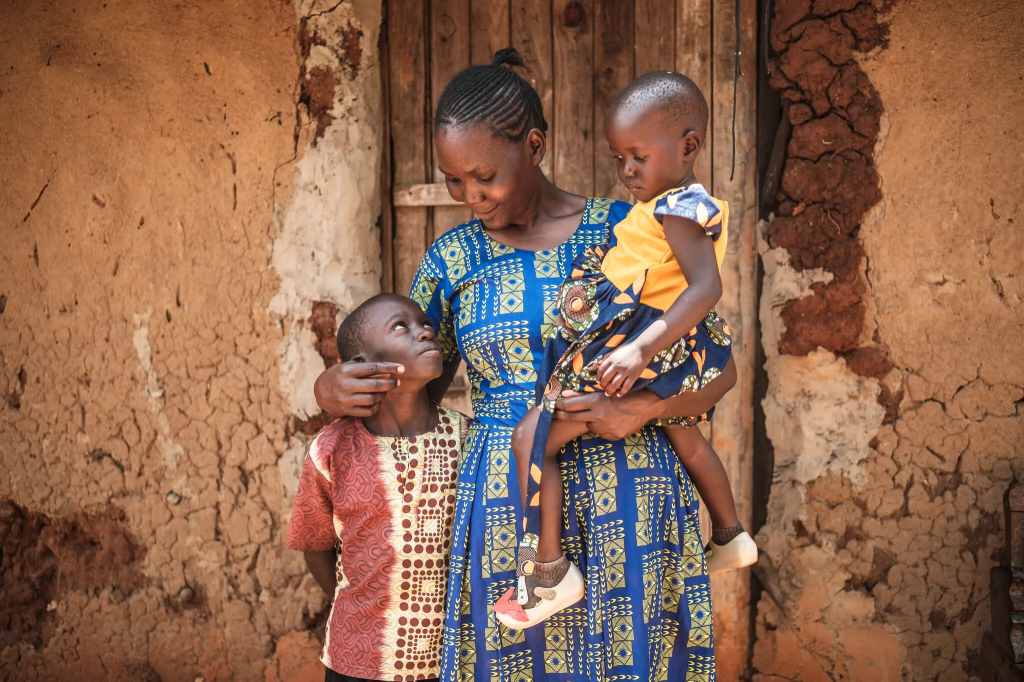
A New York Times photo of two Kenyan children, Philemon, 8, and his sister Desma, 3, who were treated for TB but still symptomatic. A followup sputum test conducted at the time of the Trump inauguration was left unanalyzed due to the halt of USAID funding.

A study published in The Lancet demonstrated that USAID funding had resulted in reductions in tens of millions of deaths from HIV/AIDS, malaria, tropical diseases, TB, nutritional deficits, and other maladies. It further projected that the Trump funding cuts, if not replaced or reinstated, would result in roughly 14 million more deaths — including more than 4.5 million in children younger than 5 years of age — by 2030. (Small parts of USAID funding that weren’t eliminated were transferred to the U.S. State Department.)

It’s difficult to report on current deaths from diseases like TB in countries like Kenya, because USAID was the agency that typically provided funds that helped clinics or other agencies track them. But journalists have found evidence, as you can see here and here.

The Trump administration, not surprisingly given its record, denies and lies. Secretary of State Marco Rubio said at a US House Foreign Affairs Committee hearing that USAID cuts had caused no deaths, adding in an exchange with Congressman Gabe Amo, a Democrat from Rhode Island, “No children are dying on my watch.”

The Washington Post wrote a fact-check article in which it unpacked Rubio’s lies, and added context that weakened his defense that the United States should be lauded because other countries either have provided little foreign aid or have been reducing it.

Rubio wasn’t alone in lying. Elon Musk shared a video in February 2025 claiming USAID had paid celebrities to travel to Ukraine. It was actually a fabricated video produced by Russia, said Darren Linvill, co-director of Clemson University’s Media Forensics Hub, in a post on X.

NBC News further unveiled how Musk had promoted the fringe conspiracy theories of ex-Trump administration official and conservative researcher Mike Benz to untruthfully portray USAID as engaging in “mass censorship of Americans, as well as global efforts to manipulate social media, rig elections and quash dissent.”

The lying is beyond shameful. Pause and think about one small part of it for a moment: A representative for the US government passed on to its citizens as the legitimate truth a piece of Russian propaganda.

And the lack of truth is especially unfortunate because there is a case for reforming humanitarian assistance. Critics, including the Trump administration, would likely take the Kenya story I related above about TB efforts nationwide ceasing and say: That’s the problem – the US pulls out and everything falls apart. We need a sustainable long-term solution with the recipient countries taking a lead role.

The Trump administration issued a new foreign aid policy in September 2025, criticizing the decades-old one as wasteful and promoting dependence. Its new foreign-aid policy now sends funds directly to other countries’ governments, with the recipient nations co-investing with the long-term intention of developing their own systems of care. **

This model is not new; former USAID administrators Deborah Kaliel and Phillip Palmer write in Foreign Policy they argued for years under Democratic and Republican administrations for a shift along these lines. They warn, however, that the change is occurring so rapidly that it risks worsening public health, causing increases in illness and death, as well as resulting in more fraud, waste, and inefficiency. Or as they put it, “replacing one flawed system with another.”

I really hope that doesn’t happen, but am very afraid it will. I don’t think it takes an expert to see that dismantling USAID almost literally overnight — and throwing away all of its expertise that had been built over decades — was a terrible decision. It was like crashing a plane mid-flight, based on the decision of a billionaire auto and space executive. Would Musk accept me or some other non-expert telling him he should immediately forever close a part of his company and fire all of its employees?

Instead of shutting it down, the administration could have ordered USAID to start shifting course — and made a gradual transition to the direction it wanted, bringing along a wealth of expertise that could have provided great feedback, saving millions of lives in the process. But instead they chose to lie and portray the civil servants who had a track record of saving lives, in the words of President Trump, as “radical lunatics.”

Footnotes

* My TB test could well have been a false positive; that was a known possibility in 1962. But unlike today, there was no blood test to turn to. Because of the research Dr. Lincoln and others conducted, the US government was on its way to an official recommendation in 1965 of isoniazid for all patients with a positive skin test, no matter their symptoms. The logic is simple:  If the patient did not have TB, the medication was unlikely to harm.  If TB was present and no action was taken, one’s life was at stake (and perhaps that of loved ones, given that it is an infectious disease). 

Although it had a potential miraculous benefit, isoniazid gave me side effects that have reverberated throughout my life. Specifically, as my mother later related to me, its bitter, metallic taste caused me to vomit and refuse foods — and I now understand that it ultimately resulted in conditioned taste aversion. In plain English: These experiences turned me from an excellent eater into a very picky one. They also heightened my anxiety and made me feel the sting of stigma three times daily as the weird boy who wouldn’t eat much of anything — not even “kid” foods like pizza, spaghetti or fried chicken (there were no nuggets in the 1960s). When I got into adolescence, I very gradually began tasting and eating foods I had avoided, one by one — a long journey to “normal” eating lasting into adulthood. I still remember worrying what my college girlfriend’s parents would serve for lunch when I met them the first time — and what they might think of me if I struggled to eat it. The irony is not lost on me that my gradual tasting was a form of exposure therapy — the method I now use as a psychologist to treat children with anxiety.

** The new Trump foreign aid policy is also explicitly America First, with the document issued by the US State Department called the America First Global Health Strategy. Its executive summary states at its conclusion: “We will also leverage our foreign assistance to promote American companies and American innovations abroad” and “promote American health innovations and products more broadly globally, helping ensure that American innovation becomes a cornerstone of health systems around the world.”

Of course, everything has pros and cons. An article in Forbes notes: “Concerns have been raised that the administration has been negotiating these agreements with minimal public disclosure. This has fueled concerns among health experts and recipient governments that the deals are structured around U.S. economic and resource extraction interests.”
Another mass shooting targets young people; let’s move towards making it one of the last

As most Americans know, there was a shooting on the Florida State University campus on April 17. I learned about it when my younger child, a freshman at FSU, texted me they were safe and staying in place.

As relieving as that news was, I am profoundly saddened for the FSU community; two adults died that day and six students were injured. And the entire campus community was affected: Some students witnessed the shooting and fled, while all on campus had to stay in place or barricade themselves. Statistically, we know some of them will develop Post-Traumatic Stress Disorder.

The accounts from the campus were agonizing.

As CNN reported, FSU junior McKenzie Heeter witnessed the gunman shoot a woman in the back. “… That’s when I realized there was no target. And that it was anybody he could see,” Heeter said. “And I took off.” And as she began to run, “It was just shot after shot after shot.”

Following the shooting, Florida State canceled all events, including a symposium created in honor of Maura Binkley, a 21-year-old FSU student murdered in 2018 at a Tallahassee yoga studio shooting that killed another person and injured several others.

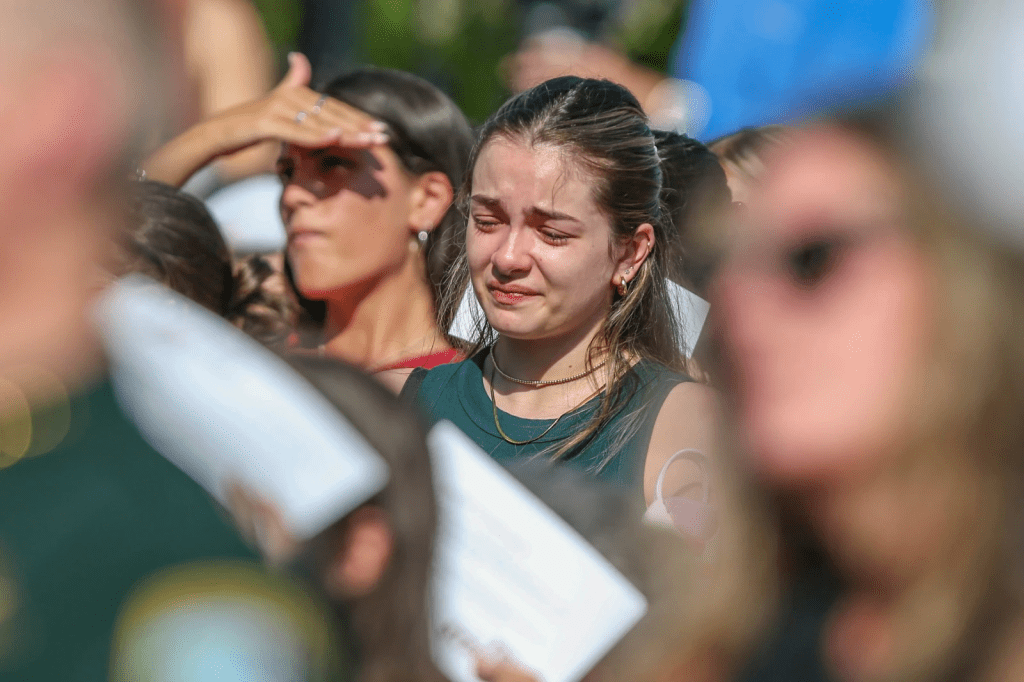
Here is an Associated Press photo of an FSU student at a vigil the day after the shooting:

Americans are highly vulnerable to being victims of mass shootings, as 73% of such shootings in the highly developed world between 1998 and 2019 took place in the US, according to a study by sociologist Jason R. Silva.

That statistic is not surprising, because the United States also has far more firearm deaths overall than comparable countries. Our nation’s firearm- homicide rate is 25 times higher and suicide-firearm rate 8 times higher than other high-income countries, according to the nonpartisan Rockefeller Institute of Government.

I don’t have all the answers for how American can solve this problem. I do know the science tells us that nations that have restricted access to guns have lower homicide rates.

And other nations that have had mass shootings have responded with legislation to limit gun violence, as The New York Times reported in 2022. This includes Canada, Norway, New Zealand, and Britain, which has one of the lowest firearm homicide rates in the world.

An interesting case study is Australia. After a mass shooting there in 1996, its conservative prime minister moved into action early in his administration.

“After this wanton slaughter, I knew that I had to use the authority of my office to curb the possession and use of the type of weapons that killed 35 innocent people,” John Howard wrote in an op-ed for The New York Times in 2013.

It wasn’t easy, but Australia wound up with comprehensive legislation that included banning semi-automatic rifles and pump-action shotguns and rifles; granting licenses to own firearms only if potential owners proved they had a reason, such as hunting, to own one; creating a buyback program for firearms that had been prohibited; limiting all gun sales to licensed dealers and requiring them to be reported to the police; and instituting a 28-day waiting period for gun purchases.

Since the legislation’s enactment, there has been a dramatic reduction in mass shootings. While it is possible this is due to chance, a study testing that possibility “found the odds against this hypothesis are 200,000 to one,” said professor Phillip Alpers of the University of Sydney.

How could the United States follow Australia’s lead? I hope it’s not too late to remember that our country has a tradition of coming together and finding bipartisan consensus on tough issues.

Prime Minister Howard has written in changing Australia’s laws he did not face a gun lobby as powerful as the US National Rifle Association. But for those interested in historical perspective, the NRA did not always oppose gun legislation; it actually used to work with the government on limiting gun trafficking.

And we do have a good starting point for consensus: Most Americans favor stricter gun laws; the Pew Research Center puts the number at 58%, with 26% saying the laws are about right and only 15% wanting them laxer. Additionally, gun owners themselves often support measures to limit gun availability.

Army veteran and retired teacher Richard Small of Charlotte, Texas, a longtime NRA member, drew national attention in the aftermath of the Uvalde, Texas, school shooting that killed 19 students and two teachers in 2022. He turned in his AR-15 rifle to local police, recognizing he didn’t need it and not wanting it to wind up in someone else’s hands (the gunman responsible for the massacre bought two AR-15s right after his 18th birthday).

Here is a photo of Mr. Small getting paperwork after handing in his rifle:

Mr. Small also became more vocal about gun control, and was moved when the public responded overwhelmingly positively to his actions. As he put it, “It hasn’t been the hate mail that I thought I was going to get.”

Shortly after the Uvalde shooting, Mr. Small was leaning against staying an NRA member. He has alternatives, including 97Percent, founded in 2019 and devoted to keeping the Second Amendment and reducing gun violence via research-driven policy initiatives that have the support of people who own guns and those who don’t.

In writing about this issue, I hope most fervently that you won’t forget about the Florida State community. You can honor them – and the many other communities and people affected by gun violence – by talking to your neighbors, writing or calling your congressperson or local representative, or getting involved with or donating to 97Percent or other groups exploring or advocating for solutions, including Moms Demand Action, Brady, Giffords, or in Rhode Island, the RI Coalition Against Gun Violence.

A horrific irony of the FSU tragedy was that it was the second mass shooting for a few students, as some had attended Marjory Stoneman Douglas High School in Parkland, Florida, where 17 people were killed and 17 wounded when a 19-year-old man opened fire on Valentine’s Day in 2018.

One of them was Jason Leavy, a freshman in high school when the shooting took place and now just a few days from graduating from FSU. He told a reporter from the Tallahassee Democrat the massacre had led him to major in psychology and to be affected by PTSD. Although he believes the constitution gives citizens the right to have guns, he wants legislation to limit what types of firearms are legal and who can own them.

“I think that’s common sense,” Leavy said, “and even if you disagree, there needs to be a solution because it seems like certain people say, ‘It is what it is, we have to accept it,’ and I don’t want to accept children dying, personally.”

A Valentine’s Day Message for our President

I did not expect my first post be a letter to the president, but this is what came out of my heart this Valentine’s Day. Children and all humans need friends — and nations do, too.

Dear President Trump,

I hope you had a happy Valentine’s Day! In Mexico, they call it El Dia del Amor y La Amistad, which means The Day of Love and Friendship.  Which is a good sentiment to perhaps allow you to pause on pronouncements and orders, as they are pushing our nation away from friendliness in ways I predict will soon haunt us.  

You might object that you don’t need friendship, that you are getting quick results!  And you have demonstrated that you can move things in your direction when you put out executive orders and threaten international leaders with tariffs.   

For example, you told Colombian President Gustavo Petro his nation would get a tariff pronto and he quieted down fast about his ideas to not accept the deportees we were sending via military planes. You threatened a 25% tariff to Mexican President Claudia Scheinbaum and Canadian Prime Minister Justin Trudeau, and each agreed to step up border enforcement (just for the record, they were working with us before).

You’ve also demonstrated that you and your friend, Elon Musk, can get results fast by making strong statements about U.S.A.I.D. – “a criminal organization.” Now you have made federal workers and programs around the world that helped people with life-threatening diseases disappear.  

Likewise, Musk told thousands of federal workers via email they could step down and take a vacation until September (although I’m really not sure I want my tax dollars paying for mass vacations) if they’ll just quit working for good.  

The trouble is that all these “wins” may add up soon to big losses.  Because friends get tired of being bullied fast.  World leaders have other options for trading partners — China, for example.  

On the international front: If you are known by other nations as a rich country that was helping them with diseases like malaria through U.S.A.I.D.– and then you vanish with barely a word, you are not going to be looked at as much of a friend anymore.  (In friend parlance, this is called “ghosting.”)  And it opens up the door for … you guessed it, a country like China, to be the new friend — and the new world leader.

Our greatest moments as a country – becoming independent, winning World War II, and leading the world into a stable era of decades of peace, prosperity, and freedom – have come with the help of allies.  And when we’ve helped other nations, they have remembered. One small but relevant example in recent times:  When the United States asked countries for help in fighting wars in Iraq and Afghanistan, Denmark joined us. Now, for reasons I don’t understand, you are threatening Denmark over its territory of Greenland.

Meanwhile, at home, a great strength of our democracy has been an ongoing cadre of civil servants who have worked mostly without political bias across Republican and Democratic administrations to protect Americans (military, FBI, police), give them justice (judges, prosecutors, public defenders), improve people’s health (doctors, nurses, social workers and others at places like the VA), and undertake many other tasks (such as processing social security and Medicare payments for retired people).  

These are people whom you and Musk are, to use a phrase you seem to like, treating very badly.  Out of nowhere, you gave them very little time to decide whether they needed to leave their jobs or risk losing them, as there were vague threats to them that they might not have employment later if they didn’t leave right away.

Here we run into something that goes past friendship.  The U.S. Constitution says clearly Congress has the power to fund agencies.  If you’re deciding you can de-fund them, that would represent your oath of office to support and defend the constitution.  

I’m feeling sad in the aftermath of Valentine’s Day, because in many cases, the ideas behind your actions have merit.  I doubt many people would disagree that U.S.A.I.D. and other federal programs could be improved.  It’s just that taking a sledgehammer to programs isn’t improving – it’s destroying.

And once you’ve destroyed things – friendships, alliances, programs, the Constitution – it can be a very long, hard road to get them back.