As most Americans know, there was a shooting on the Florida State University campus on April 17. I learned about it when my younger child, a freshman at FSU, texted me they were safe and staying in place.
As relieving as that news was, I am profoundly saddened for the FSU community; two adults died that day and six students were injured. And the entire campus community was affected: Some students witnessed the shooting and fled, while all on campus had to stay in place or barricade themselves. Statistically, we know some of them will develop Post-Traumatic Stress Disorder.
The accounts from the campus were agonizing.
As CNN reported, FSU junior McKenzie Heeter witnessed the gunman shoot a woman in the back. “… That’s when I realized there was no target. And that it was anybody he could see,” Heeter said. “And I took off.” And as she began to run, “It was just shot after shot after shot.”
Following the shooting, Florida State canceled all events, including a symposium created in honor of Maura Binkley, a 21-year-old FSU student murdered in 2018 at a Tallahassee yoga studio shooting that killed another person and injured several others.
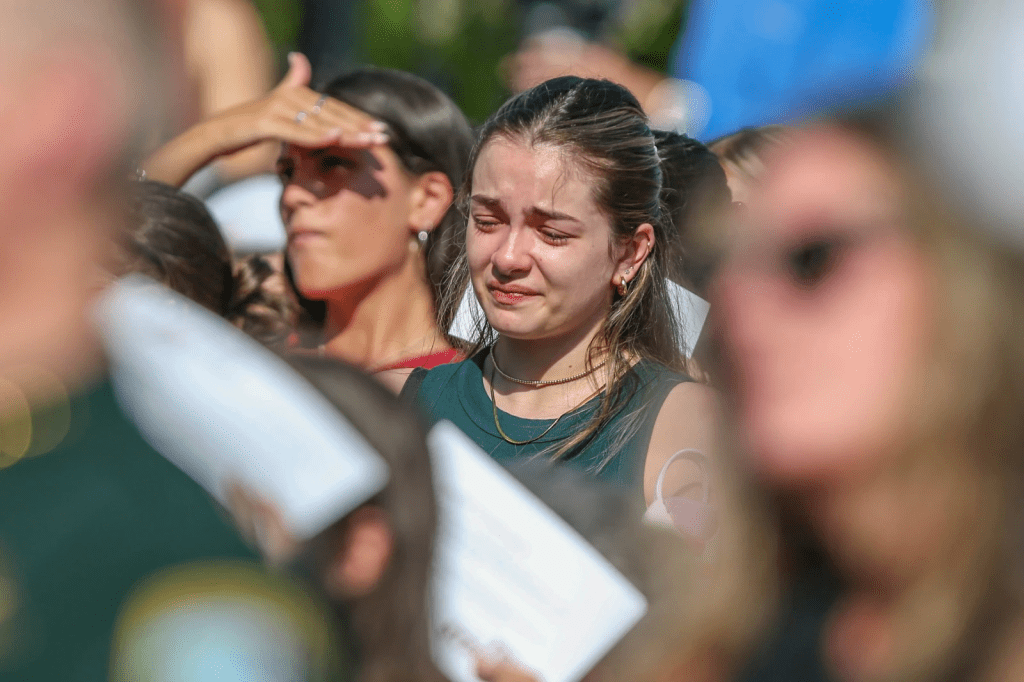
Here is an Associated Press photo of an FSU student at a vigil the day after the shooting:
Americans are highly vulnerable to being victims of mass shootings, as 73% of such shootings in the highly developed world between 1998 and 2019 took place in the US, according to a study by sociologist Jason R. Silva.
That statistic is not surprising, because the United States also has far more firearm deaths overall than comparable countries. Our nation’s firearm- homicide rate is 25 times higher and suicide-firearm rate 8 times higher than other high-income countries, according to the nonpartisan Rockefeller Institute of Government.
I don’t have all the answers for how American can solve this problem. I do know the science tells us that nations that have restricted access to guns have lower homicide rates.
And other nations that have had mass shootings have responded with legislation to limit gun violence, as The New York Times reported in 2022. This includes Canada, Norway, New Zealand, and Britain, which has one of the lowest firearm homicide rates in the world.
An interesting case study is Australia. After a mass shooting there in 1996, its conservative prime minister moved into action early in his administration.
“After this wanton slaughter, I knew that I had to use the authority of my office to curb the possession and use of the type of weapons that killed 35 innocent people,” John Howard wrote in an op-ed for The New York Times in 2013.
It wasn’t easy, but Australia wound up with comprehensive legislation that included banning semi-automatic rifles and pump-action shotguns and rifles; granting licenses to own firearms only if potential owners proved they had a reason, such as hunting, to own one; creating a buyback program for firearms that had been prohibited; limiting all gun sales to licensed dealers and requiring them to be reported to the police; and instituting a 28-day waiting period for gun purchases.
Since the legislation’s enactment, there has been a dramatic reduction in mass shootings. While it is possible this is due to chance, a study testing that possibility “found the odds against this hypothesis are 200,000 to one,” said professor Phillip Alpers of the University of Sydney.
How could the United States follow Australia’s lead? I hope it’s not too late to remember that our country has a tradition of coming together and finding bipartisan consensus on tough issues.
Prime Minister Howard has written in changing Australia’s laws he did not face a gun lobby as powerful as the US National Rifle Association. But for those interested in historical perspective, the NRA did not always oppose gun legislation; it actually used to work with the government on limiting gun trafficking.
And we do have a good starting point for consensus: Most Americans favor stricter gun laws; the Pew Research Center puts the number at 58%, with 26% saying the laws are about right and only 15% wanting them laxer. Additionally, gun owners themselves often support measures to limit gun availability.
Army veteran and retired teacher Richard Small of Charlotte, Texas, a longtime NRA member, drew national attention in the aftermath of the Uvalde, Texas, school shooting that killed 19 students and two teachers in 2022. He turned in his AR-15 rifle to local police, recognizing he didn’t need it and not wanting it to wind up in someone else’s hands (the gunman responsible for the massacre bought two AR-15s right after his 18th birthday).
Here is a photo of Mr. Small getting paperwork after handing in his rifle:

Mr. Small also became more vocal about gun control, and was moved when the public responded overwhelmingly positively to his actions. As he put it, “It hasn’t been the hate mail that I thought I was going to get.”
Shortly after the Uvalde shooting, Mr. Small was leaning against staying an NRA member. He has alternatives, including 97Percent, founded in 2019 and devoted to keeping the Second Amendment and reducing gun violence via research-driven policy initiatives that have the support of people who own guns and those who don’t.
In writing about this issue, I hope most fervently that you won’t forget about the Florida State community. You can honor them – and the many other communities and people affected by gun violence – by talking to your neighbors, writing or calling your congressperson or local representative, or getting involved with or donating to 97Percent or other groups exploring or advocating for solutions, including Moms Demand Action, Brady, Giffords, or in Rhode Island, the RI Coalition Against Gun Violence.
A horrific irony of the FSU tragedy was that it was the second mass shooting for a few students, as some had attended Marjory Stoneman Douglas High School in Parkland, Florida, where 17 people were killed and 17 wounded when a 19-year-old man opened fire on Valentine’s Day in 2018.
One of them was Jason Leavy, a freshman in high school when the shooting took place and now just a few days from graduating from FSU. He told a reporter from the Tallahassee Democrat the massacre had led him to major in psychology and to be affected by PTSD. Although he believes the constitution gives citizens the right to have guns, he wants legislation to limit what types of firearms are legal and who can own them.
“I think that’s common sense,” Leavy said, “and even if you disagree, there needs to be a solution because it seems like certain people say, ‘It is what it is, we have to accept it,’ and I don’t want to accept children dying, personally.”
 A Child Psychologist's Worries, Hopes and Other Thoughts on the World We're Creating for Children